
Stump Grinding guide
How to Prepare for Your Stump Grinding Call
The Short Answer First
To prepare for a stump grinding call, you need three things ready: the stump's approximate size (diameter at ground level), access information for the grinder to reach it, and any knowledge of underground services nearby. That covers 90% of what an operator will ask you.
The rest of this article fills in the detail so the conversation goes smoothly, you get an accurate quote the first time, and there are no surprises on the day.
What the Operator Actually Needs to Know
When you ring about stump grinding, you are essentially helping the operator build a mental picture of the job. They cannot see your yard yet, so they are working from what you tell them.
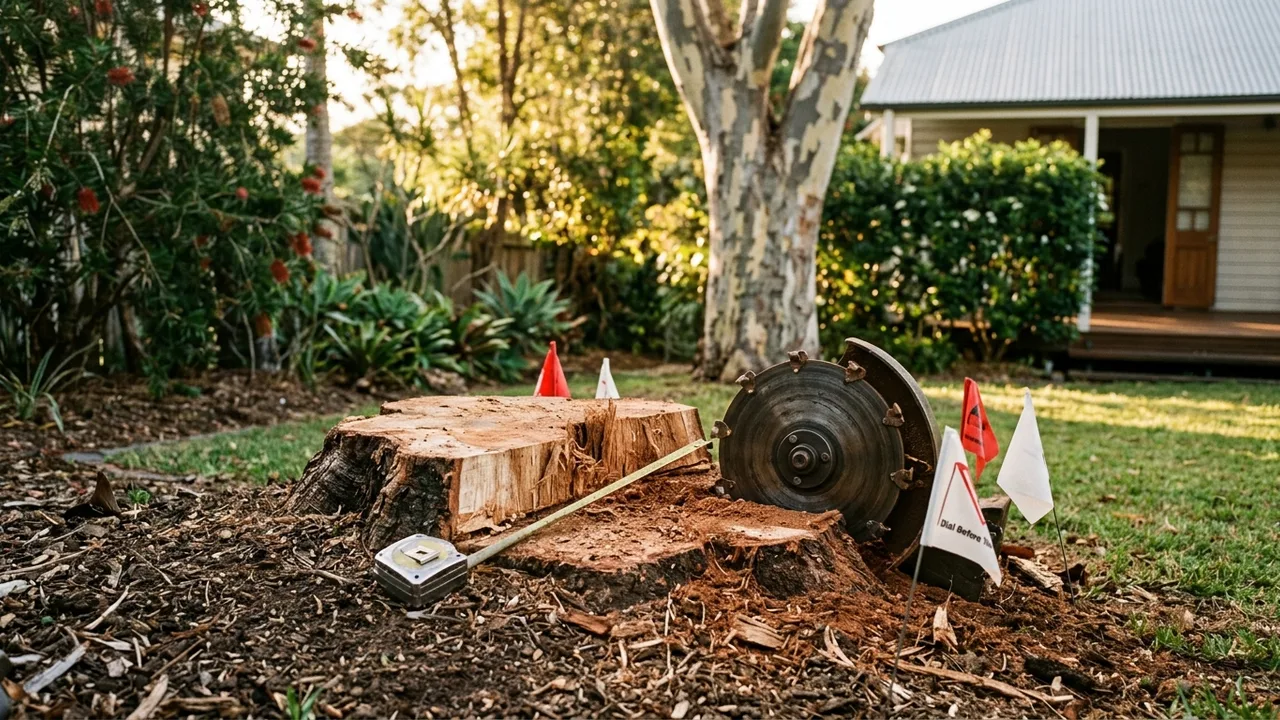
Here is what matters most:
Stump diameter. Measure across the widest point at ground level, in centimetres. A 30 cm stump from a standard garden tree is a very different job from an 80 cm stump left by a large Moreton Bay fig or brush box. Diameter is the single biggest driver of price, because it determines grinding time and how hard the machine works.
Number of stumps. If you have more than one, tell them upfront. Multi-stump jobs typically attract a better per-stump rate because the travel and setup cost is spread across the visit. Most operators, us included, prefer to know the full picture before arriving.
Approximate tree species, if you know it. Hardwoods like tallowwood, ironbark, and brush box are significantly denser than softer species. A stump that looks modest in diameter can take much longer to grind if the timber is particularly hard. You do not need to be certain, but "I think it was a jacaranda" or "it was some sort of gum tree" is genuinely useful.
Age of the stump. Fresh stumps are harder to grind than older ones. If the tree was cut down recently, say so. If it has been sitting there for five years and is already partly rotted, that matters too, and usually makes the job easier.
Access: The Detail Most People Overlook
This is where jobs hit unexpected snags. A stump grinder is a heavy, wide piece of machinery. The standard walk-behind machines used on residential properties in suburbs like Chelmer, Indooroopilly, and Sherwood typically need a gate opening of at least 90 cm to pass through a side gate. Some larger machines need more.
Before you call, check:
- Gate width. Measure the clear opening, not the gate itself. Hinges and frames eat into that number.
- Ground slope. If your yard drops away sharply from the house, or there is a steep kerb crossing to reach the stump, mention it. Steep terrain limits which equipment can be used safely.
- Overhead clearance. Low-hanging eaves, carport roofs, or pergolas near the stump can restrict machine operation.
- Obstacles between the gate and the stump. Garden edges, raised garden beds, retaining walls, or a trampoline that would need moving all affect how the operator can manoeuvre.
In the older Queenslander-era streets of Graceville, Fairfield, and Yeronga, properties often have narrow side passages and raised subfloors that make access trickier than a newer home in Moorooka or Corinda. It is worth walking your own access path before calling.
Underground Services: Do Not Skip This
This is the most important safety conversation before any grinding job.
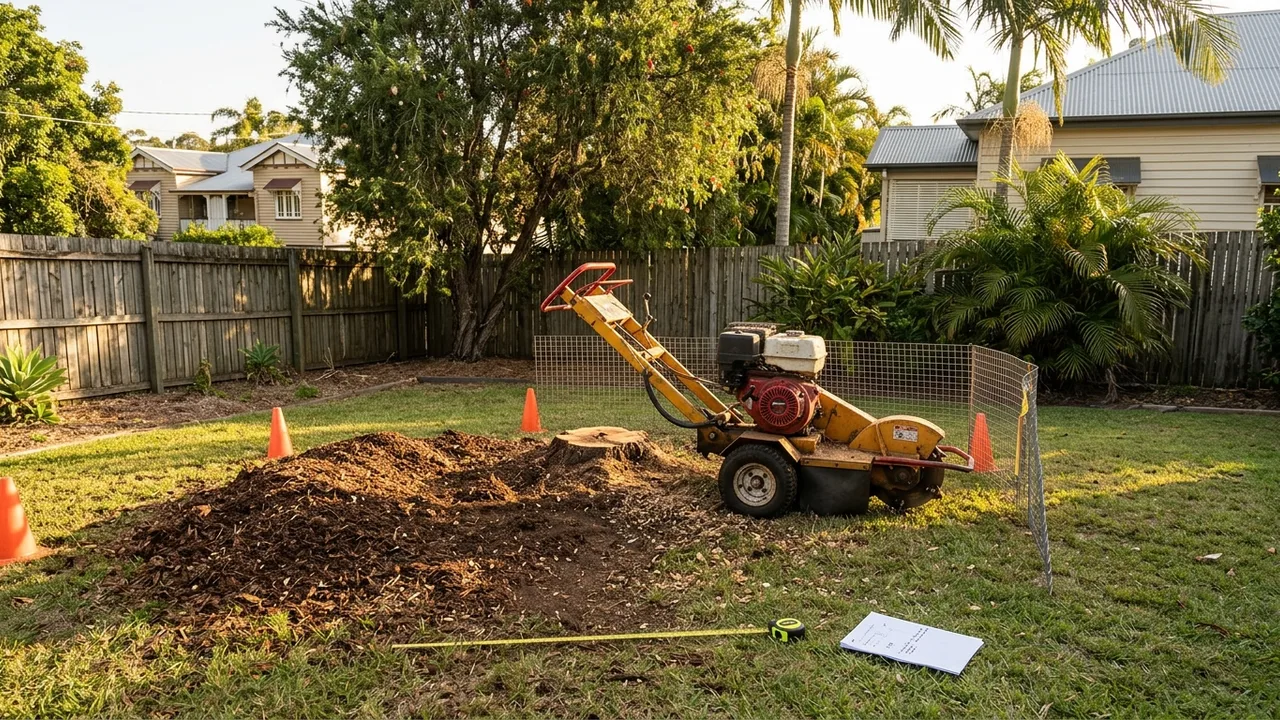
Stump grinders work below ground level, typically to 200-300 mm depth in a standard residential grind. Root system removal goes deeper. If there are irrigation lines, water pipes, electrical conduits, or Foxtel/NBN cabling buried near the stump, they are at risk.
Here is what you should do before the call:
- Check your council or water utility records if you have them. Brisbane City Council's asset maps can sometimes indicate mains infrastructure, though private services on your property are your responsibility to know about.
- Think about what you have installed. Garden irrigation is easy to forget. Outdoor power outlets near garden beds often have underground cabling running to them. Pool equipment typically has buried conduits.
- Look at the original landscaping plans if you have them from when you bought or built.
If you genuinely do not know whether services are nearby, say that honestly on the call. A good operator will either use a locating service, grind conservatively, or recommend you get a dial-before-you-dig check done first. Dial Before You Dig (1100) is a free national service for property owners.
We take this seriously on every job we do. A clipped irrigation line is a frustration; a clipped electrical conduit is a serious hazard.
Cost Expectations and What Affects the Quote
Residential stump grinding in Brisbane typically starts around $150-$200 for a small single stump with easy access, and can reach $800-$1,000 or more for large, hard, or awkward jobs. Our jobs generally fall in the $200-$1,000 range.
The variables that push a quote up:
- Larger diameter (the main factor)
- Hard timber species
- Fresh-cut stumps
- Restricted access requiring a smaller, slower machine
- Surface roots requiring additional grinding beyond the main stump
- Chip cleanup and backfilling (ask whether this is included or quoted separately)
The variables that bring a quote down:
- Multiple stumps in one visit (spreading the call-out cost)
- Open, flat access with no obstacles
- Older, partially decomposed stumps
When you call, ask specifically whether the quote includes chip and debris cleanup. The grinding process leaves a significant volume of wood chip spoil in the hole. Some operators leave it, expecting you to spread or dispose of it yourself. We offer chip and debris cleanup as a separate service and will include it or quote it separately depending on what you want.
On the Day: How to Make It Go Smoothly
Once you have booked, a few simple things help the job run without delays.
Clear the area around the stump. Move pot plants, garden ornaments, tools, and anything else within about two metres. Grinding throws chips with some force.
Secure pets and keep children away from the work area. The machine is loud and the debris projection zone is real. A closed door or a back room is fine.
Mark any known service locations. If you have irrigation lines or you know there is a cable nearby, use a stake or some spray paint to indicate it before the operator arrives. It takes two minutes and avoids any ambiguity.
Be available for a quick question at the start. You do not need to stand and watch the whole job, but being around for the first five minutes means the operator can confirm details and point out anything unexpected before work starts.
A Realistic Closing Thought
Preparing well for this call is not complicated. Measure the stump, walk the access path, think about buried services, and know roughly how many stumps you are dealing with. That puts you and the operator on the same page before a quote is even discussed.
If you are in Chelmer, Taringa, St Lucia, Indooroopilly, Graceville, Sherwood, Corinda, Yeronga, Fairfield, or Moorooka, we cover your suburb and can usually give you a ballpark figure over the phone from good information. If the job has complications, we will tell you that too, rather than quote low and revise on arrival.
When you are ready, give us a call with those measurements in hand. It makes the whole thing quicker for both of us.
Quick answers