Stump Grinding guide
Is There a Best Time of Year to Grind Stumps in Brisbane?
Is There a Best Time of Year to Grind Stumps in Brisbane?
Honestly, yes and no. Brisbane's subtropical climate means stump grinding is practical year-round, but some seasons are clearly easier to work in than others. If you have flexibility, late autumn through winter is the sweet spot. If you don't, there's still no reason to leave a stump sitting in your yard for months waiting for perfect conditions.
Here's what actually matters, season by season.
What Brisbane's Climate Does to the Stump Grinding Process
Stump grinding is a mechanical process. A rotating carbide-tipped wheel chews through timber and root material down to below ground level. Rain doesn't stop that, cold doesn't stop that, and Brisbane doesn't get cold enough to freeze ground or change soil structure the way it does further south.
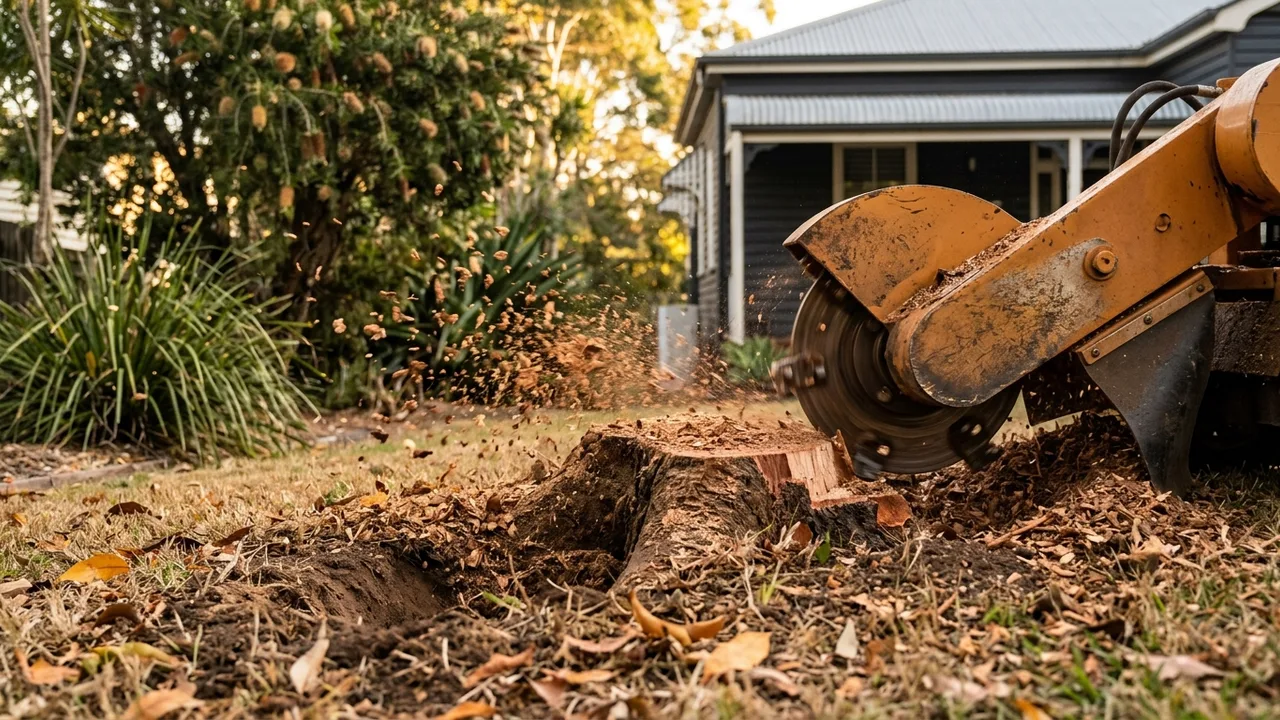
What does change with the seasons is the working environment around the job. Soil moisture affects how deeply a grinder can track into the root zone. Ground hardness affects the edges of the job, particularly for root system removal along paths and driveways. Heat affects how long an operator can work safely, and how quickly timber dries out between rainfall events.
So the climate question is less "can we grind?" and more "how cleanly and efficiently can we get the result you want?"
Why Winter (June to August) Is Generally the Easiest Time
Brisbane winters are mild and dry. Days sit in the low-to-mid twenties, humidity drops noticeably compared to summer, and the rain eases off. For stump grinding, this translates to a few practical advantages.
Ground conditions are firmer. After the wet season drains away, soil in suburbs like Chelmer, Graceville, and Sherwood tends to firm up reasonably well by June. Firmer ground means the grinder tracks more predictably, the chip spoil is easier to manage, and post-grind backfilling settles better.
Trees are doing less. Many Brisbane deciduous trees (leopard trees, jacarandas, Queensland brush box) slow their root activity in cooler months. If a stump has a shallow root system that's still active, grinding in winter means less immediate regrowth pressure from suckers at the stump perimeter. This isn't a hard rule, but it's worth knowing.
Operator and equipment work better in the cool. This is straightforward. Working a grinder in 32-degree heat with 85% humidity is harder on equipment and harder on the person doing the job. Winter conditions make for a cleaner, safer workday.
Access to yards is often better. Lawn growth slows in winter. There's less dense vegetation to clear around the stump, and visibility of any surface roots is better without thick grass growth covering them.
Summer Grinding: What You're Trading Off
Brisbane summers (December to February) are hot, humid, and wet. None of that makes stump grinding impossible, but it does change what you're dealing with.
Soil in Inner West Brisbane, especially in lower-lying spots near the river in Yeronga, Corinda, and St Lucia, can become waterlogged after heavy rain events. Grinding into saturated soil produces a wet chip mix that's heavier to move, doesn't pack back down cleanly, and can take longer to dry before you can turf over the area.
Summer also brings more active root systems. Trees that were felled earlier in the year may have stumps that are still sending energy into surface roots. You can still grind those effectively, but if you're hoping to minimise any sucker regrowth, summer isn't the ideal timing.
That said, summer is exactly the right time for emergency stump clearance after storm events. Brisbane's storm season (roughly November to March) brings the bulk of storm-felled trees. If a tree comes down on your property in Indooroopilly or Moorooka during a summer storm, you're not waiting until June to deal with the resulting stump.
The trade-off is this: summer grinding often costs the same as winter grinding but involves slightly messier site conditions. The result is the same; it just takes a bit more cleanup.
Spring and Autumn: the Middle Ground
Spring (September to November) is a mixed bag. It's warming up, rain is picking up ahead of the wet season, and trees are pushing new growth hard. Soil conditions are reasonable early in spring before the wet season kicks in. By October and November, you're heading into summer conditions.
Autumn (March to May) is arguably the second-best window. Rain typically eases after March, temperatures are falling, and soil starts to drain out from the summer wet. By April in suburbs like Taringa and Fairfield, ground conditions are often solid enough for clean root system removal work. Autumn is also a popular time for site preparation grinding, as homeowners start planning spring-summer landscaping or pool projects and want stumps out of the way before the next wet season.
If you're planning a site preparation job (clearing stumps ahead of a new fence line, garden redesign, or pool installation), booking in autumn gives you good working conditions and enough lead time to landscape before summer.
When Timing Doesn't Matter: Just Get It Done
There's an argument that all this seasonal analysis is somewhat academic. Stumps are tripping hazards. They harbour termites. They stop you mowing cleanly. They complicate fencing quotes. Every month a stump sits in your yard is a month those problems persist.
In Brisbane's climate, the quality difference between a winter grind and a summer grind is marginal compared to the ongoing nuisance of leaving the stump in place. The chip spoil can always be cleaned up. Sucker regrowth can be managed. A spongy patch of lawn after a wet-season grind dries out.
The suburbs we cover, from Chelmer and Graceville through to Moorooka and Fairfield, all have a similar enough climate that there's no month where grinding is genuinely a bad idea. The main seasonal consideration is lead time: summer storm season means more demand for emergency clearances, so scheduling a non-urgent job in the wet season can sometimes mean a longer wait.
If your stump job is non-urgent, winter and early autumn offer the cleanest working conditions. If it's urgent, do it now.
A Few Practical Tips Before You Book
- Clear around the stump yourself if you can. Removing pot plants, garden ornaments, and loose edging near the stump saves time on the day regardless of season.
- Know your underground services. Dial Before You Dig (1100) is worth a call before any root system removal job, particularly where stumps sit close to driveways or near the kerb. We work carefully around marked services, but knowing where they are upfront prevents delays.
- Think about what comes next. If you're turfing over the grind area, plan for at least a few weeks of settling before laying new turf, ideally in cooler months when soil moisture is more stable.
- Multiple stumps in one visit bring the cost per stump down noticeably. If you've got three stumps on a Sherwood quarter-acre and you've been putting off the job, booking them together makes more financial sense than separate jobs across different seasons.
Closing Recommendation
If you have the luxury of choosing when to book, aim for May through August. Dry soil, mild temperatures, and slower-growing vegetation all make for a cleaner result. If your stump is a hazard, an eyesore, or sitting in the way of a project you want to start, don't wait for the perfect month.
Stump grinding is not a complex, season-sensitive trade like laying turf or treating for lawn grubs. The equipment works year-round, the ground in Brisbane stays workable year-round, and the result is the same regardless of whether there's a jacaranda blooming overhead or not.
If you'd like a rough idea of cost before committing, drop us a message with a photo of the stump (or stumps) and we can give you a realistic figure without needing a site visit in most cases. That's often the most useful first step.
Quick answers