Stump Grinding guide
Which Tree Species Are Hardest to Grind in Chelmer and Indooroopilly?
Which Tree Species Are Hardest to Grind in Chelmer and Indooroopilly?
The short answer: ironbark, tallowwood, and mature fig trees are consistently the toughest stumps we deal with across the Inner West. If you have one of these on your property, expect longer grinding time, heavier wear on equipment, and a higher quote than a softwood species of similar size.
That said, difficulty is not just about the species. The age of the tree, how long the stump has been sitting, soil type, and root spread all factor in. Here is a closer look at what makes certain species genuinely hard work, and what that means for your job.
The Species That Give Grinders the Most Trouble
Ironbark and Spotted Gum
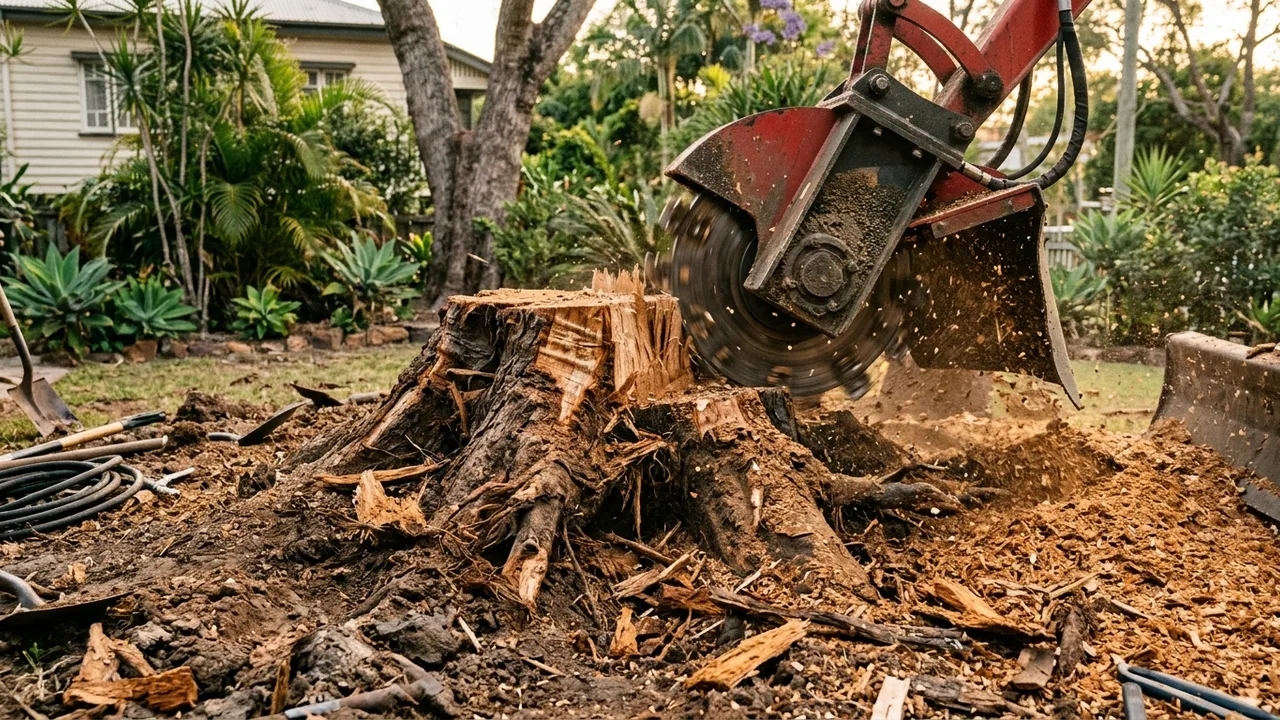
These two eucalyptus species are among the densest hardwoods in the region. Ironbark in particular has a Janka hardness rating typically around 14,000 newtons — roughly five times harder than pine. When an ironbark has been growing for 30 or 40 years in a Chelmer backyard, the stump is almost stone-like once it dries out.
Spotted gum is slightly softer but still well above average. Both species require slower passes with the grinding wheel, and the teeth on the cutter wear down faster, which affects job time and cost.
Tallowwood
Tallowwood (Eucalyptus microcorys) is common in older established gardens across Indooroopilly, Taringa, and Sherwood. It has a dense, interlocked grain that does not chip away cleanly. Instead, it tends to tear in chunks, which makes the grinding process less predictable. It also tends to retain moisture longer than most eucalypts, which can actually make it slightly easier to cut when freshly felled but much harder once the stump has aged.
Moreton Bay Fig
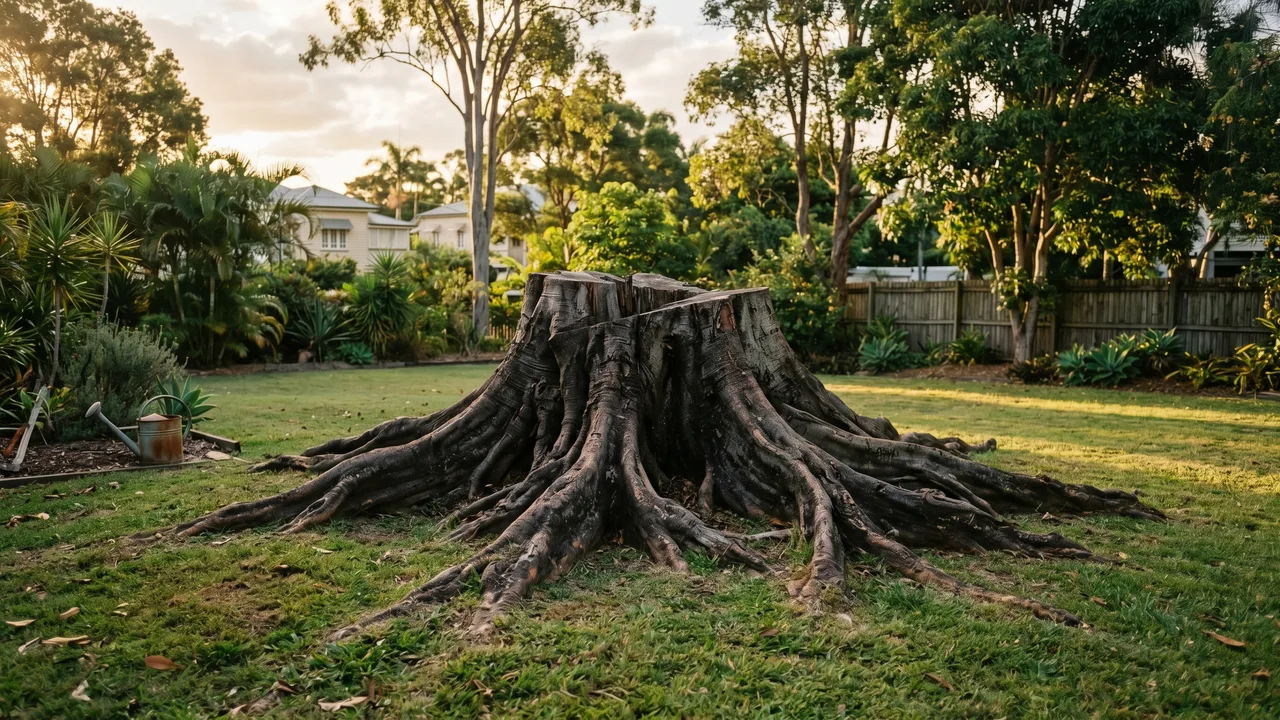
The Moreton Bay fig (Ficus macrophylla) deserves its own mention because the challenge is less about wood density and more about sheer root volume. These trees produce enormous, wide-spreading surface roots that can extend 10 to 15 metres from the base. The timber itself is moderately hard, but the root system makes the job significantly more complex.
In suburbs like St Lucia and Indooroopilly, Moreton Bay figs are common as street trees and in older residential gardens. If a root has buckled your driveway or path, the grinding work needed to address that goes well beyond the stump itself.
Brush Box
Brush box (Lophostemon confertus) is widely planted as a street tree throughout Brisbane's Inner West and frequently appears in residential gardens that backed onto older council plantings. It is dense, grows quickly, and develops a wide root flare at the base. The combination of hardness and root complexity makes it a slow grind.
Why Soil and Site Conditions in This Area Matter
The Inner West suburbs sit in a transition zone between clay-heavy soils closer to the river and sandier ground on the rises. Chelmer, Graceville, and Sherwood properties near the flood plain often have heavier clay soils, while parts of Taringa and Indooroopilly sit on more friable ground.
Clay soil complicates root removal because the roots bind tightly with the earth. When we are grinding surface roots that have grown laterally through clay, the machine is effectively pulling against packed soil as well as cutting through wood. This slows progress and increases debris.
Sandier soils are generally easier to work in, but they also allow roots to travel further and faster. A tallowwood in sandy Indooroopilly soil may have roots three or four metres from the stump that still need addressing if you are laying new paving or a garden bed.
Fresh Stump vs Aged Stump: Does It Actually Make a Difference?
Yes, it does, and the answer is counterintuitive for hardwoods.
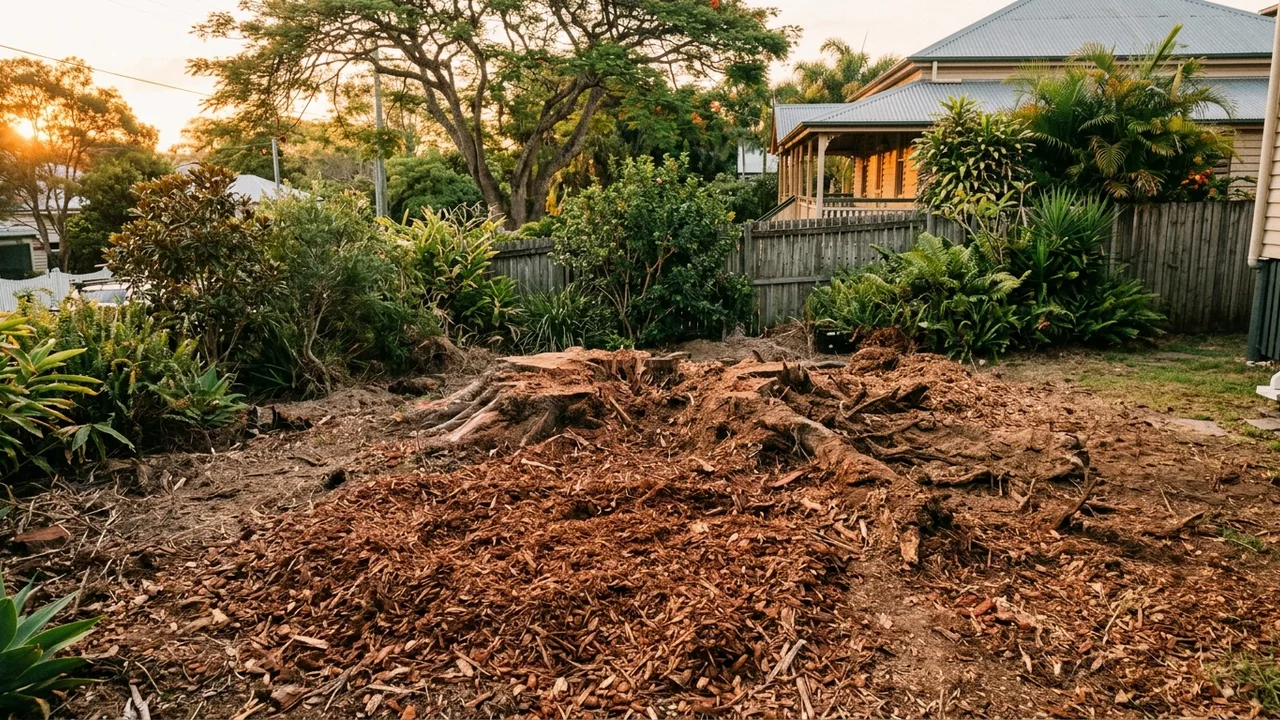
With softwood species (think camphor laurel, which is prolific across Yeronga and Fairfield), a fresh stump is harder to grind than an aged one because the green wood is tough and fibrous. Leaving it for six to twelve months softens it considerably.
With ironbark, tallowwood, and most dense eucalypts, the opposite is often true. Fresh cuts are easier. As these species dry out, the timber becomes harder and more brittle in ways that actually increase wear on grinding equipment. If you have a recently felled ironbark and are on the fence about when to book the stump grinding, sooner is generally better.
Moreton Bay fig stumps are the exception again. They retain moisture for a long time and can begin to soften with age, but the root system problem does not diminish over time.
Cost and Time: What to Expect for Hard Species
A standard single softwood stump in a straightforward location typically falls at the lower end of the $200 to $1,000 range we see across most Inner West jobs. A large ironbark or tallowwood stump, or a fig with significant surface roots, will trend toward the middle or upper end of that range.
The variables that push cost up are:
- Stump diameter above 600 mm. Most eucalypts left from mature trees fall in this category.
- Root removal beyond the stump. This applies most to figs, brush box, and large spotted gums.
- Access constraints. Many Chelmer and Graceville properties have older fencing or narrow side gates that limit machine size, requiring a smaller grinder that takes longer.
- Multiple stumps from one species. If you have three ironbarks to clear, a multi-stump quote will save you money compared to booking them separately.
It is worth being upfront with us about the species when you call, if you know it. It genuinely helps us quote more accurately and tell you whether the job is a half-hour or a half-day.
Camphor Laurel: A Special Case Worth Mentioning
Camphor laurel (Cinnamomum camphora) is technically a softer timber, but it comes up often enough in Fairfield, Moorooka, and Yeronga that it warrants a mention. It is a declared Class 3 invasive plant in Queensland. The wood itself grinds relatively easily, but the chemical compounds in the timber mean the chips are not safe to use as mulch around food gardens. They can also irritate skin and airways during grinding.
We always flag this to homeowners before the job. The chip debris from camphor laurel should not be spread across vegetable beds or compost. It is fine as a path mulch or to bag and dispose of, but it is one situation where the cleanup and disposal decision matters more than usual.
Practical Recommendations Before You Book
If you are planning to grind a stump in Chelmer, Indooroopilly, or any of the surrounding suburbs, a few things will make the job go more smoothly.
Identify the species if you can. A photo of the bark, leaves, or any remaining timber sent through with your enquiry helps us assess the job remotely. You do not need to know the Latin name, just "that big gum with the dark furrowed bark" tells us something useful.
Consider the full root picture. For figs and brush box especially, think about where the roots have travelled. If you are grinding a stump before new paving or a fence line, surface root removal may save you a more expensive repair job in two years.
Do not wait on ironbark and tallowwood. If the tree is recently felled, booking sooner rather than later is genuinely in your interest with these species.
For multiple stumps, ask about a combined rate. We work across a compact cluster of suburbs, and clearing two or three stumps on the same visit almost always works out better value for you than separate bookings.
There is no urgency here, and no pressure. If you want to call and describe what you have before committing to anything, that is a perfectly reasonable way to start.
Quick answers