Stump Grinding guide
How Tree Roots Damage Driveways and Pipes in the Western Suburbs
How Tree Roots Actually Damage Your Driveway and Pipes
Tree roots damage driveways and pipes by exerting slow, relentless mechanical pressure and by exploiting any existing crack or joint in their search for water. It is not dramatic or fast. It is a quiet, years-long process that most homeowners in the western suburbs only notice once the damage is already expensive.
Understanding how it works can save you from a nasty surprise when you pour the concrete, replace the stormwater line, or decide to sell.
Why the Western Suburbs Are Particularly Vulnerable
The streets running through Chelmer, Graceville, Sherwood, Indooroopilly and Corinda are lined with mature trees - many of them well over thirty years old. Large poinciana, fig, liquidambar, jacaranda and Moreton Bay fig specimens are common here, and they are precisely the species that produce aggressive, wide-spreading root systems.
A few factors make this pocket of Brisbane especially prone to root damage:
- Older infrastructure. Houses in the 4068, 4075 and 4103 postcodes were largely built between the 1940s and 1980s. The original earthenware sewer pipes, terracotta drainage lines and unreinforced concrete driveways from that era were not designed with root intrusion in mind.
- Clay-heavy soils. Much of the inner west sits on reactive clay. During dry spells the soil shrinks away from pipes and slab edges, leaving gaps that roots can track into. When rain returns, the clay swells again, amplifying the pressure.
- Large block sizes. Bigger blocks mean more trees, closer to structures, with more room for a root system to expand laterally before anyone notices a problem.
- Proximity to the river and creeks. Suburbs like St Lucia, Chelmer and Yeronga sit near the Brisbane River floodplain. Moisture gradients below ground can pull roots toward pipes even when surface conditions seem fine.
None of this is catastrophic in isolation. But combined, these factors mean the odds of root-related damage are genuinely higher here than in a newer suburb built on sandy soil with PVC (polyvinyl chloride) pipes.
What Roots Actually Do to a Driveway
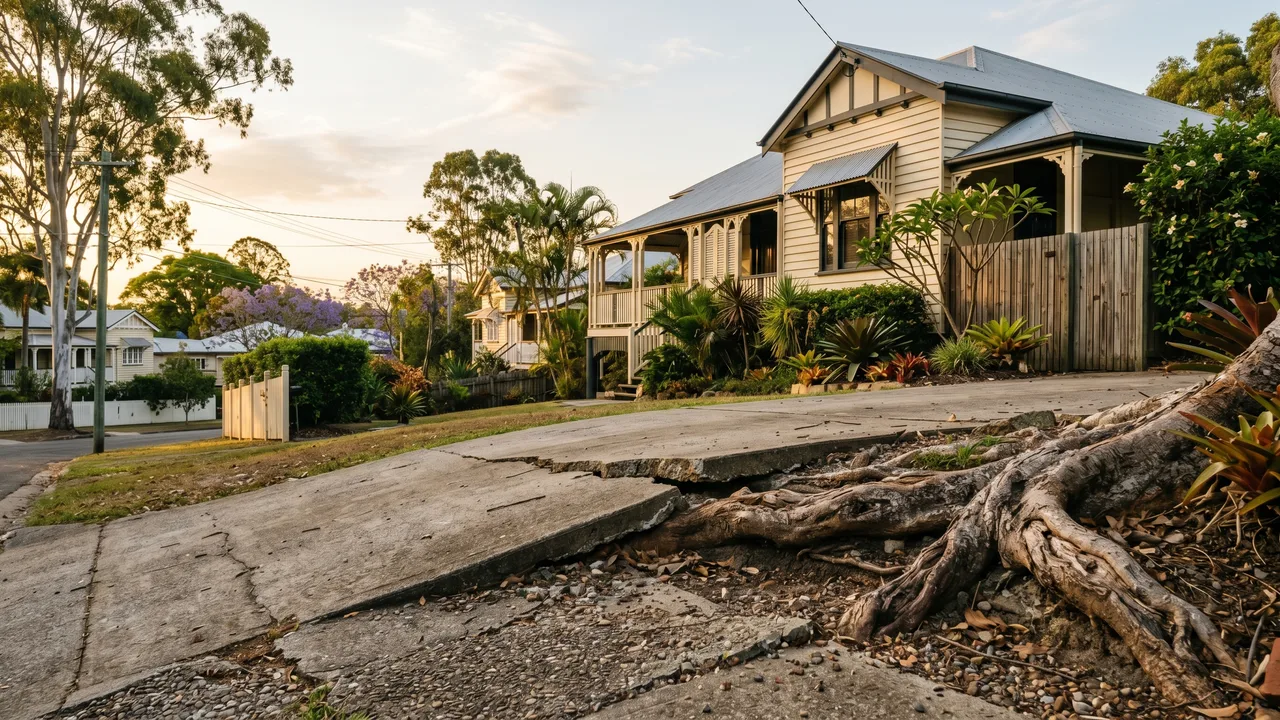
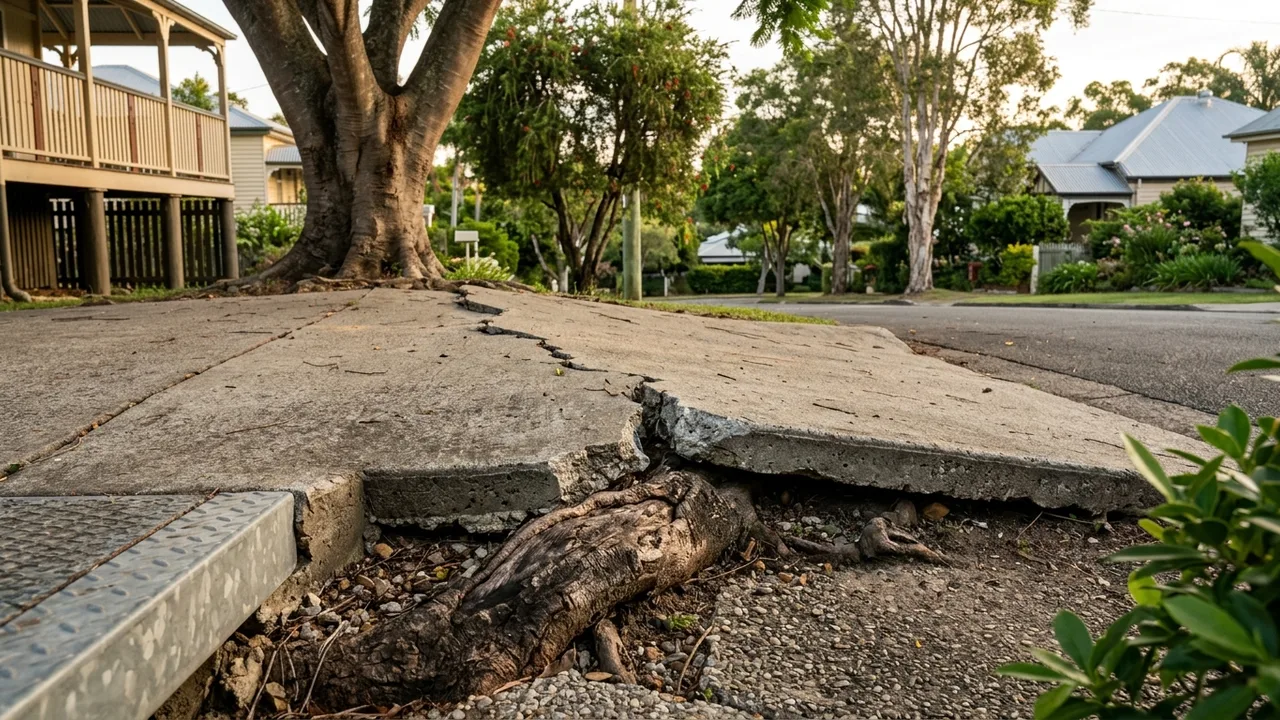
A root does not smash through concrete. It finds a hairline crack, a control joint or the edge where a slab meets a kerb, and it grows into that space. Over two to five years the root thickens. As it thickens, the concrete above lifts or fractures.
What you typically see:
- A ridge or heave running in a rough line across the slab
- Cracking that radiates outward from a tree trunk in a fan pattern
- The edge of the driveway lifting away from the kerb or garden bed
The problem compounds because lifted concrete traps water, accelerating further cracking and creating a trip hazard. If you just re-pour the concrete without addressing the root below, the same thing will happen again within a few years. Typically, roots from trees within four to six metres of a driveway are the culprit, though some species (particularly figs and poincianas) can extend their roots much further than that.
A common approach in suburbs like Taringa and Fairfield is to install a physical root barrier (a vertical HDPE sheet driven 600-900 mm into the ground between the tree and the structure) at the time of driveway repair. This can redirect root growth downward rather than outward. It does not guarantee a permanent fix, but it buys time and reduces the frequency of repairs.
The trade-off is cost: root barriers add $300-$800 or more to a driveway repair job, depending on the linear metres required. That might feel like a lot. Over ten years it is usually cheaper than two re-pours.
What Roots Do to Pipes and Drains
Pipes attract roots because they carry moisture, nutrients and oxygen. Even a perfectly sealed modern pipe radiates slight temperature and humidity differences that roots can detect. An older earthenware or concrete pipe with a slightly offset joint is essentially an open invitation.
Once a root enters a pipe joint it does not simply block the pipe. It grows a fibrous mass called a root ball inside the pipe, which catches toilet paper, grease and other waste. The first sign is usually slow drainage or a recurring blockage that clears temporarily with a plunger and comes back within weeks.
Left alone, the root mass grows until the pipe cracks under the combined pressure of the root, the surrounding soil movement (particularly on clay), and the water pressure inside. A cracked sewer line in a suburb like Moorooka or Corinda can cost $3,000-$10,000 or more to repair, depending on depth, access and whether Council infrastructure is involved.
A licensed plumber can run a CCTV drain camera through the line to assess the extent of root intrusion before deciding on a repair strategy. This typically costs $200-$400 and is money well spent before committing to excavation.
Removing the Stump vs. Just Cutting the Tree
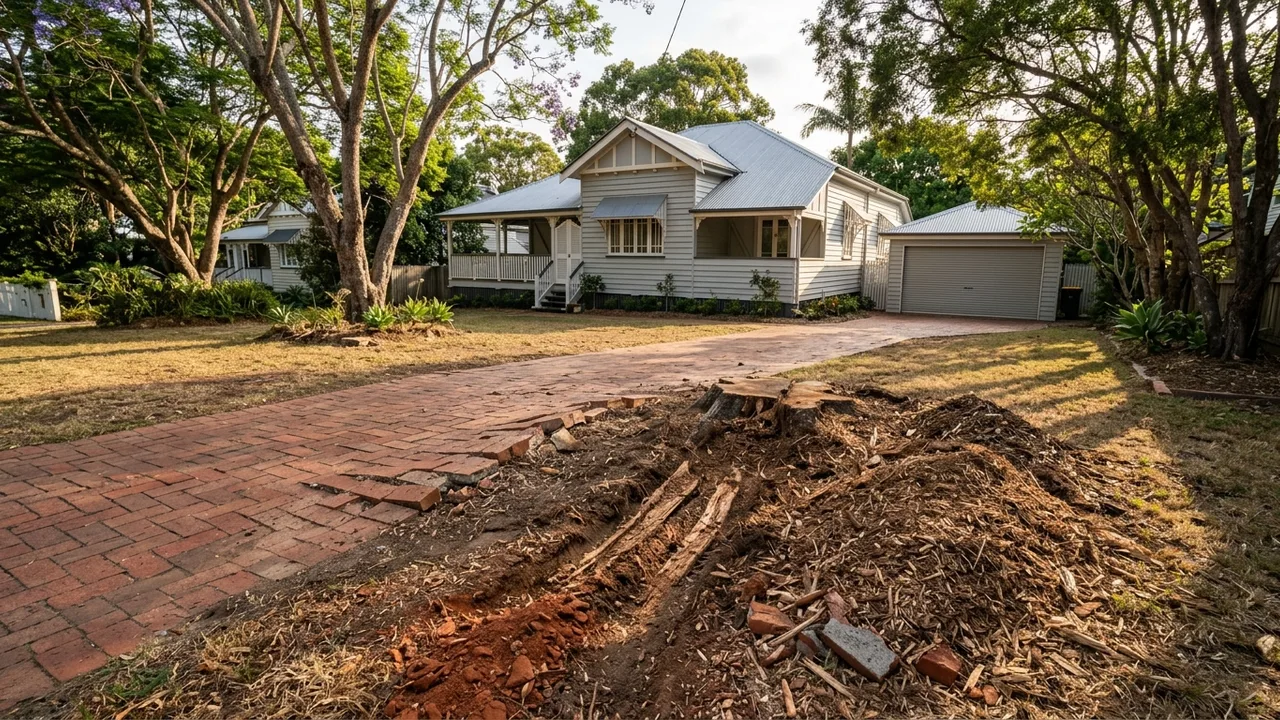
This is a point where a lot of homeowners make a costly mistake. If a tree is damaging your driveway or threatening your pipes, having it felled is only half the job. A felled tree with the stump left in the ground will continue to produce root growth for one to three years, sometimes longer, depending on the species. The roots do not immediately die.
Beyond that, a stump left at ground level or just below it is an obstacle for any repair work. Concreters, pavers and plumbers all charge more (or simply refuse) to work around a stump.
Grinding the stump to 200-300 mm below ground level removes the physical anchor point for the root system and makes it practical to cut and extract the major lateral roots that are nearest to your structures. We offer root system removal as a separate service specifically for situations where surface grinding alone is not enough - where lateral roots are running toward a driveway, path or known pipe route and need to be traced and extracted to a reasonable depth.
It is worth being honest here: stump grinding does not magically remove every root in the ground. Smaller feeder roots will decompose naturally over one to two years. What grinding does is eliminate the live growth pressure from the main root structure, which is typically the source of ongoing mechanical damage.
How to Assess Your Own Risk Before Calling Anyone
You do not need a professional to do an initial risk assessment. Walk around the property and note:
- Any tree within six metres of a concrete driveway, path or paved area
- Any tree within four metres of a sewer inspection opening, stormwater grate or downpipe connection
- Existing cracks, heaves or ridges in concrete that run roughly toward a tree
- Slow-draining fixtures inside the house (basin, shower, toilet) that have no obvious cause
If you tick two or more of these, it is worth getting a plumber to scope the drain and an arborist (or a stump grinder) to assess the root spread around any stumps or trees being considered for removal.
One practical tip: Council of the City of Brisbane has a street tree management program, and trees in the verge (between your fence and the kerb) are technically Council's responsibility. If a Council street tree is damaging your driveway or connecting pipe infrastructure, log it with Council before spending your own money. Resolution can be slow, but Council does cover repair costs in legitimate cases.
A Practical Way Forward
If you have already had a tree removed and a stump is sitting near a driveway or drain line, the sensible sequence is: grind the stump and major roots first, let a plumber assess the pipe, and then repair the surface. Doing it the other way around - repairing the concrete before removing the stump - is usually a waste of money.
For trees that are still standing and causing concern, the decision is more nuanced. Removing a healthy, large tree is not always the right answer. Sometimes root barriers, adjusted drainage and a monitoring schedule are enough. An arborist can give you an honest assessment of whether the tree is salvageable in place.
What we can help with at Stump Grinding Chelmer is the grinding work itself - once the tree decision is made, we handle the stump and root extraction across Chelmer, Graceville, Sherwood, Indooroopilly, Taringa, St Lucia, Corinda, Yeronga, Fairfield and Moorooka. If you want to talk through what the root situation looks like before booking, you are welcome to call and describe what you are seeing. Sometimes a brief conversation can save a lot of unnecessary work.
Quick answers