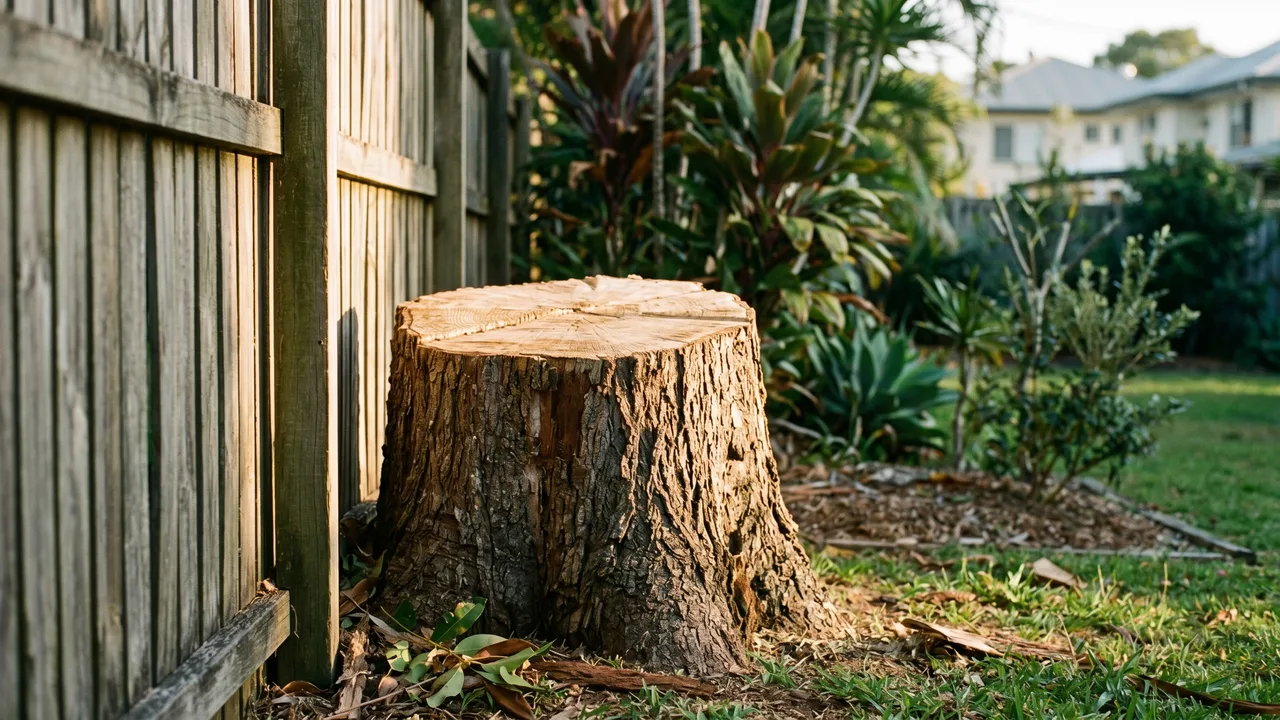
Stump Grinding guide
Can a Stump Be Ground Down When It Sits Right Next to a Fence or Path?
Yes, It Can Be Done - But the Margin for Error Gets Tight
Yes, a stump can typically be ground down when it sits close to a fence or path. The short answer is that proximity to a structure doesn't automatically rule out mechanical grinding. What it does change is the approach, the equipment choice, and in some cases the price.
That said, "close" covers a lot of ground. A stump sitting 300mm from a paling fence is a very different job from one that's half-buried under a concrete path or touching a colorbond panel. Understanding those differences helps you have a more useful conversation with whoever is doing the work.
What "Close to a Fence or Path" Actually Means in Practice
Stump grinders work by spinning a toothed cutting wheel (sometimes called a cutting disc or grinding wheel) across the top and sides of the stump. The machine needs enough clearance to swing that wheel without the blade or its housing making contact with an adjacent structure.
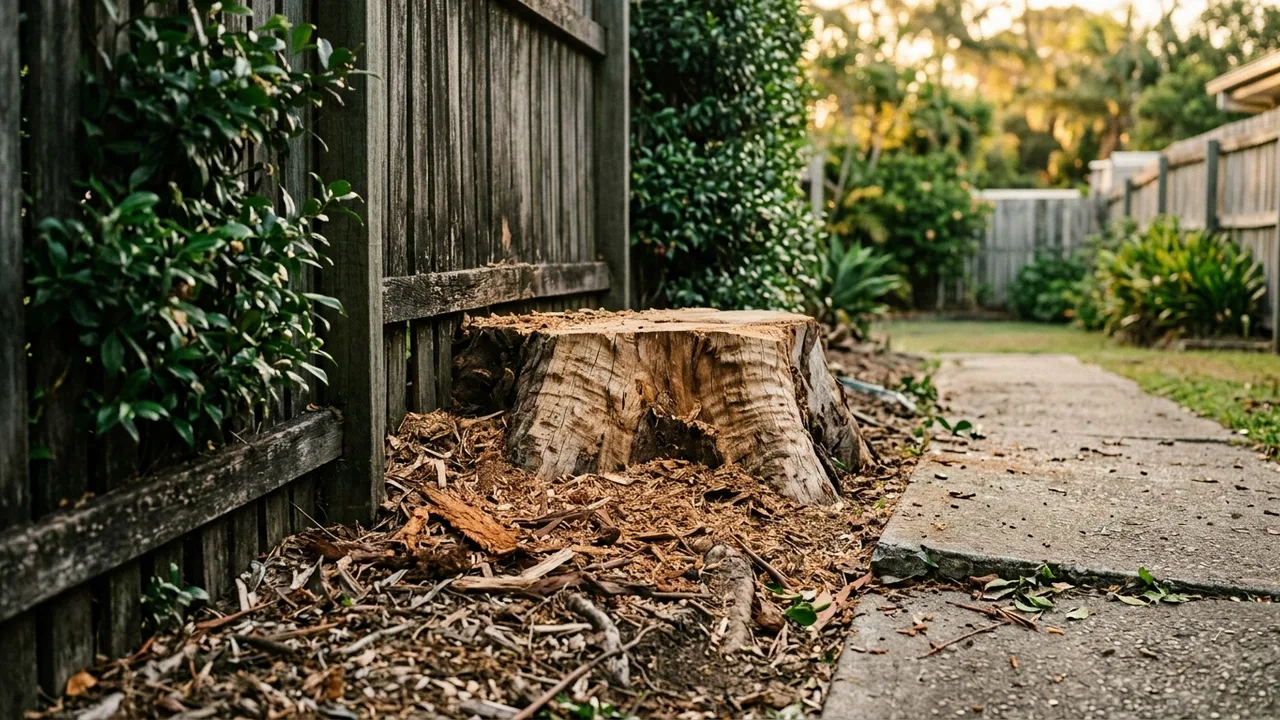
As a rule of thumb, most standard-size walk-behind grinders need roughly 150mm to 300mm of working clearance on at least one side to operate safely and effectively. That's not a lot. Many stumps in suburban Brisbane backyards sit well within that range of a fence.
There are a few scenarios that come up regularly in the Inner West suburbs we cover - Chelmer, Graceville, Sherwood, Corinda and the surrounding area:
- Paling or timber fences close to the stump. The cutting wheel can damage soft timber if the operator isn't careful, and old fences in particular can be fragile.
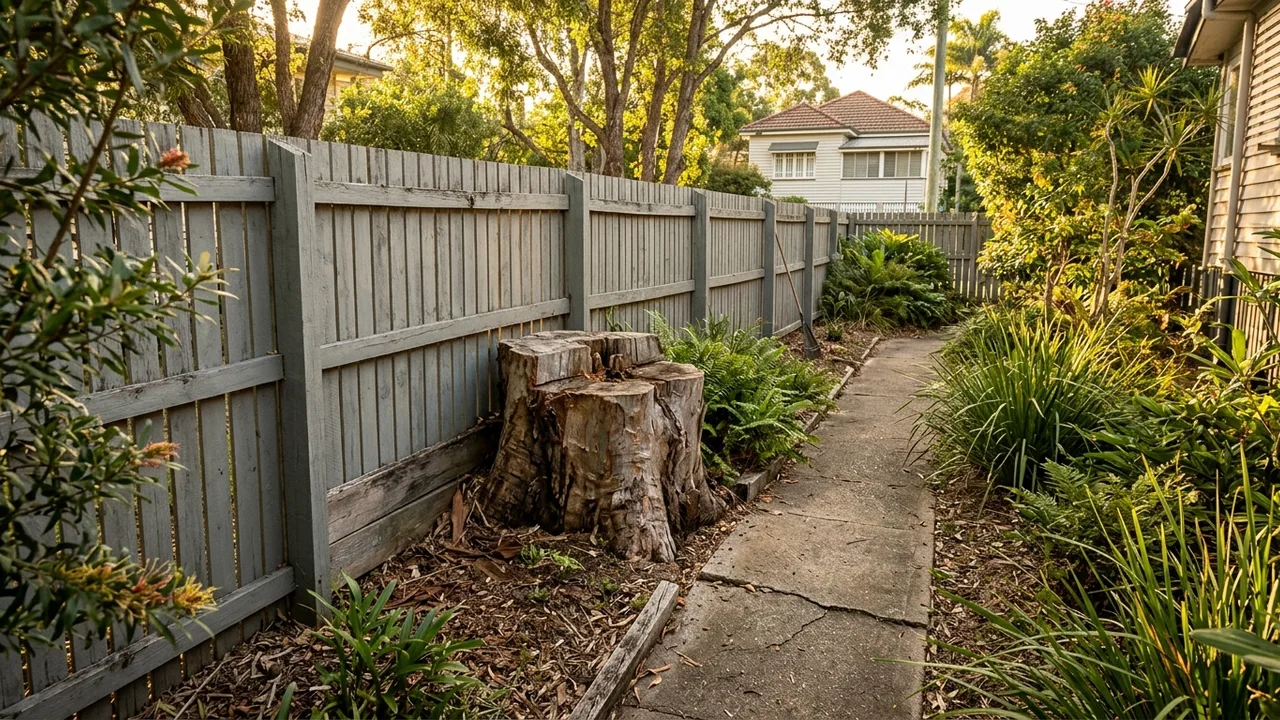
- Concrete or brick paths where the stump's surface roots run underneath and have actually lifted the edge of the path.
- Colorbond fencing right at the property boundary, often because the tree was planted right on the fence line years before anyone thought about removal.
- Retaining walls on sloped blocks. This is common in areas like Taringa and St Lucia where the terrain drops away toward Toohey Forest or the river.
The Equipment Question: Size Really Does Matter Here
Most operators have access to more than one machine. Smaller, pedestrian-operated grinders are slower and less powerful than tracked ride-on machines, but they can fit through a standard side-gate (typically around 900mm wide) and work in tighter spots.
Larger stumps - say, anything over 400mm in diameter - are usually better handled with a bigger machine, but a big machine can't always reach the stump without risking the fence. In those situations a competent operator will typically:
- Use a smaller grinder to do the edge work closest to the fence or path.
- Bring in the larger machine for the open sections where there's more room to work.
- In tight situations, hand-cut some of the remaining wood with a chainsaw before grinding.
This combination approach takes longer and costs a little more, but it's usually the right call. Rushing with an oversized machine next to an old timber fence is how fences get cracked.
One thing worth knowing: in older Brisbane suburbs, a lot of backyard fences are closer to the end of their life than they look. A Queenslander-era paling fence in Chelmer or Moorooka may be technically still standing but won't take much lateral vibration. A good operator will note this before they start and talk through any risk with you.
When the Root System Runs Under the Path
This is where things get more complicated. Sometimes the stump itself has enough clearance to grind, but the lateral roots have grown horizontally under a concrete path or driveway edge. Grinding the stump down to sub-surface level is straightforward enough, but if those roots aren't addressed, they'll continue to decompose in place, which can cause the path surface to sink or crack over time.
Root system removal - deep grinding and extraction of the lateral roots themselves - is a separate service and a more involved job. It requires careful work to avoid hitting underground services like water pipes or conduit. In Brisbane, it's worth checking Dial Before You Dig (Australia's free underground service locating referral service) before any deep root work happens close to a path or driveway.
On reactive clay soils, which are common across the Inner West, removing a large root mass can also change how moisture moves through the soil directly under a hard surface. This isn't usually a reason to avoid the work, but it's worth factoring into your thinking if the path is older or already has existing cracking.
The Trade-Off: Leave It vs. Grind It
Some homeowners, particularly if the stump is at the back of the property and not in the way, wonder whether it's worth grinding at all when the location makes it tricky.
Here's an honest breakdown:
Reasons to grind it despite the difficulty:
- Stumps left in place attract termites and other wood-boring insects. In Brisbane's climate, this isn't a theoretical risk - it's a practical one, particularly in older weatherboard homes common in Graceville, Sherwood and Chelmer.
- A stump close to a fence line can cause the fence post to shift as the root system continues to change shape during decomposition.
- If you ever need to replace the fence, a buried stump makes that job harder and more expensive.
Reasons to weigh the cost carefully:
- Tight-access grinding costs more, sometimes significantly, depending on the stump size and how constrained the workspace is.
- If the stump is very small (say, under 150mm diameter) and not close to any structure or garden bed you need to use, it may decompose fast enough that grinding isn't strictly necessary.
- If the fence is already in very poor condition, you may want to replace it first, then grind without the constraint.
There's no universal right answer. The stump's size, species, location and your plans for that area all feed into it.
What to Expect from the Quoting Process
When you ask for a quote on a stump that's tight against a fence or path, any operator worth dealing with should want to see the situation before giving you a firm price. A photo helps, but an on-site look is better for anything genuinely complicated.
Things that affect the price in a tight-access job:
- Stump diameter (the main driver of cost on any job)
- Distance from the fence or path (under 100mm is a different category from 250mm)
- Whether root system work is needed under the path
- Whether grindings need to be bagged and removed or can be left as mulch
- Whether the fence will need any protective covering or temporary removal of a panel
For a single stump in a standard backyard in Chelmer or Yeronga, a tight-access job typically runs somewhere between $250 and $600. Root work under a concrete path adds to that figure depending on the scope. These are rough figures; every site is different.
We carry our own equipment and assess each job individually, so if you're unsure whether yours is even feasible, a quick conversation or a site visit is the right starting point.
A Sensible Way to Think About It Before You Call
Before you contact anyone, it helps to know a few things about your stump:
- Roughly how wide is it at the base (in centimetres)?
- How far is the nearest fence panel, post or path edge?
- Is the fence timber, colorbond, or something else?
- Are there any obvious surface roots running toward the path?
- Do you need the grindings removed, or are you happy to use them as garden mulch?
Having those answers ready makes the quoting conversation quicker and more accurate. You don't need to measure to the millimetre, but a rough idea of the clearance helps us tell you straight away whether it's a standard job, a tight-access job, or something that needs a site visit first.
If the stump is in a suburb we cover - anywhere from Indooroopilly through to Fairfield and Moorooka - we're happy to take a look and give you an honest answer about what's involved before any money changes hands.
Quick answers