Stump Grinding guide
Do Old Tree Stumps Attract Termites in Brisbane?
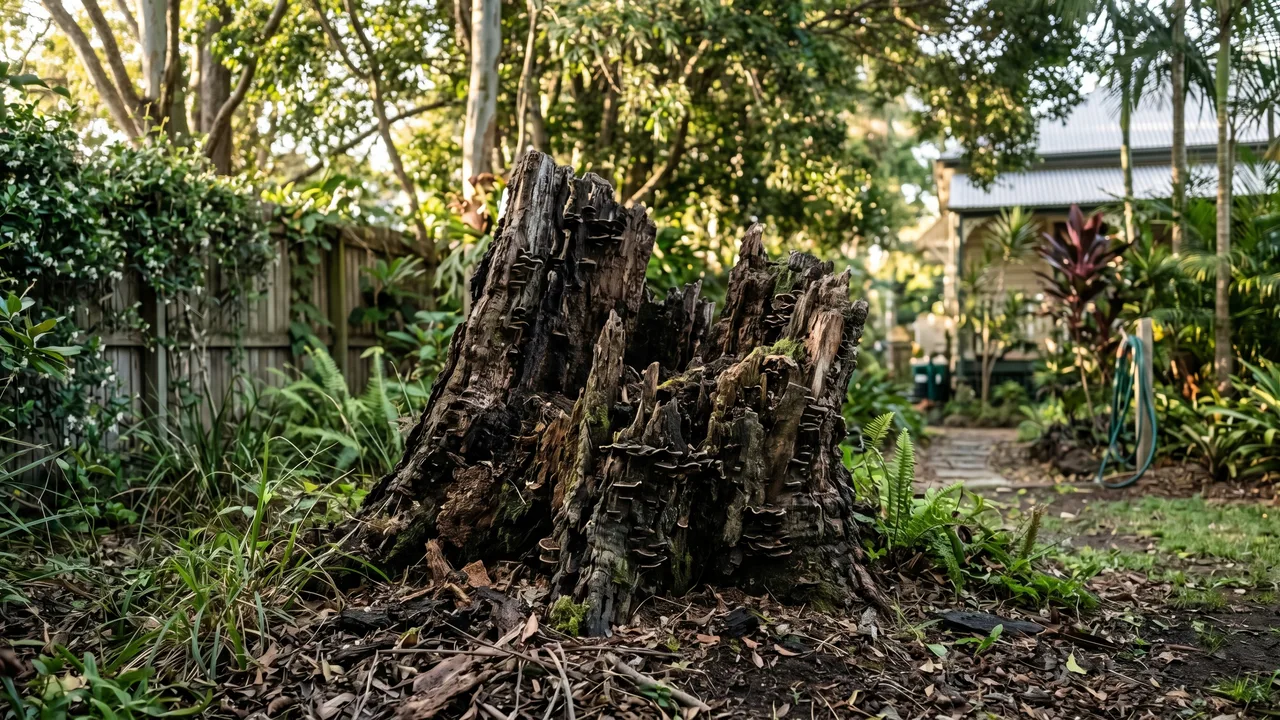
Yes, old tree stumps do attract termites in Brisbane. A decaying stump is essentially a slow-release food source sitting in warm, moist soil — exactly what subterranean termite colonies look for. The risk is real, and in suburbs like Chelmer, Sherwood, and Graceville where large Eucalyptus, Camphor Laurel, and Poinciana trees are common, leftover stumps are a recurring issue.
Why Decaying Wood Is Termite Habitat
Termites don't appear overnight. They find their way to a stump through underground tunnels, often from an existing colony already established somewhere in the soil of your property or a neighbouring yard.
The decay process is the key driver. When a tree is cut down, the stump begins to die. The heartwood softens, the bark loosens, and moisture from Brisbane's humid summers is absorbed into the grain. That combination — softened cellulose, warmth, and moisture — creates prime foraging conditions for subterranean termites, particularly Coptotermes acinaciformis, which is the species responsible for most structural damage across Queensland.
A fresh, healthy stump is less immediately attractive. But within 12 to 18 months, depending on stump species and rainfall, decay progresses enough to make it viable termite territory. In Brisbane's subtropical climate, that timeline shortens in summer and stretches slightly in drier winters, but there is no real "safe" season.
How Close Is Too Close to Your House?
This is where homeowners in older Brisbane suburbs should pay close attention. A stump 15 metres from your house might feel safely distant, but subterranean termites forage through underground galleries that can extend 50 to 100 metres from the colony's main nest. Distance from the house does not equal distance from the risk.
In the Inner West, a lot of properties sit on 600 to 800 square metre blocks with mature trees close to the house or straddling fence lines. If a neighbour has a stump on their side that goes untreated, the foraging tunnels can cross a boundary without anyone seeing them. Conversely, your stump can be the staging point for a colony that then targets your house, your neighbour's deck, or structural timbers under an elevated Queenslander.
The practical rule: any stump within 50 metres of a timber structure deserves attention. That includes garden sheds, fences, decks, and subfloor framing.
Signs a Stump Already Has Termite Activity
You often won't see the termites themselves. They work under cover, inside the wood or in mud tubes along the root system. What you might notice:
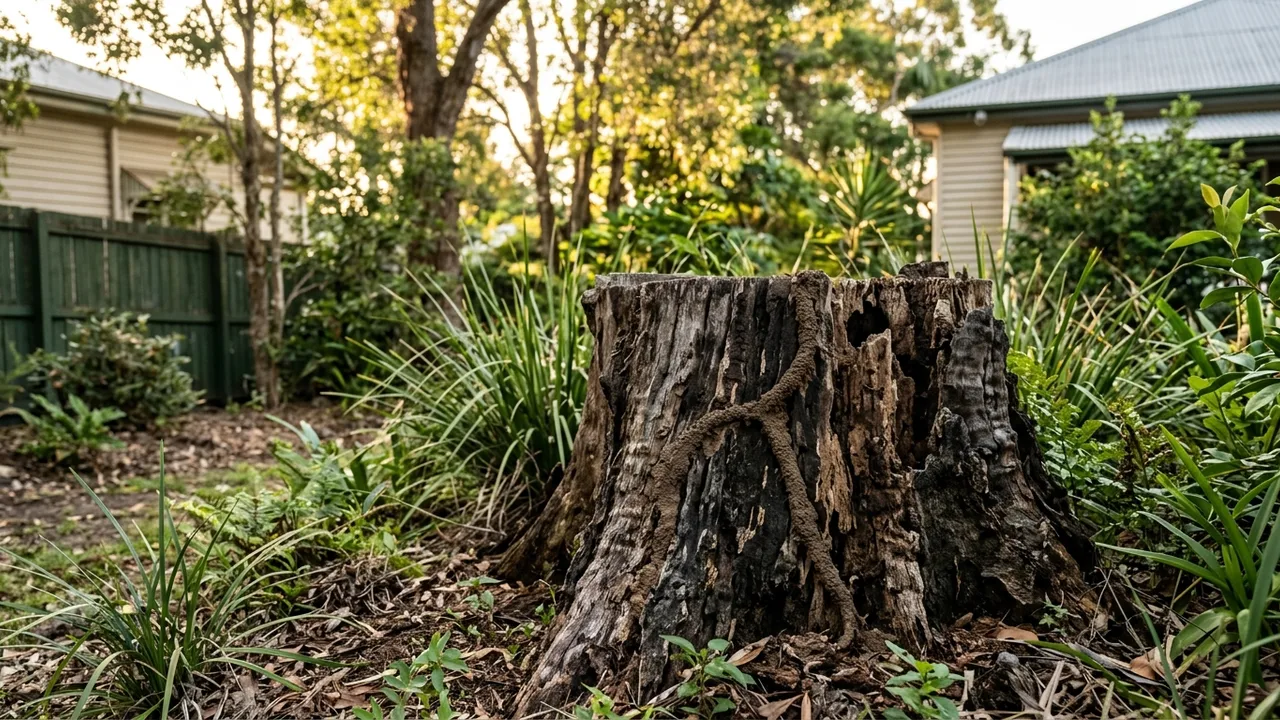
- Mud tubes on the base of the stump or along exposed surface roots. These are roughly pencil-width tunnels made from soil, saliva, and frass. They protect termites from light and dehydration.
- Soft or hollow-sounding wood when you tap the stump with something hard. A healthy stump sounds dense; an infested one sounds papery.
- Sawdust-like frass around the base. This is expelled material from their galleries, though it can also indicate borers rather than termites.
- Swarmers (winged reproductives) around the stump during humid evenings, typically between October and February in Brisbane. Finding discarded wings near the stump base is a strong indicator.
- Collapse under foot pressure. If the stump crumbles when you stand on it, the internal structure may already be heavily compromised.
If you spot any of these signs, the stump should be treated before removal, or at minimum inspected by a licensed pest controller. Disturbing an active colony without a plan can scatter termites and temporarily push them deeper into surrounding soil or towards your house.
Stump Grinding vs Chemical Treatment vs Doing Nothing
There are three realistic options when you have a stump you're worried about. Each has genuine trade-offs.
Doing nothing is the cheapest short-term choice and the most common one. It's also the riskiest. A stump that sits for several years in Brisbane soil will eventually decay fully, but "eventually" can mean five to fifteen years depending on the species. A Camphor Laurel stump, common in Chelmer and Taringa, is particularly slow to break down because the wood contains natural oils that resist decay — but termites will still colonise it. A Poinciana stump, common in Yeronga and Fairfield, breaks down faster but is more immediately attractive to termites.
Chemical treatment typically means having a licensed pest controller apply a termiticide to the stump or surrounding soil. This can suppress or eliminate an active colony, and it forms part of a broader perimeter barrier. It does not remove the food source. The stump stays in the ground and continues to decay; you've just interrupted the current activity. If termite pressure is high in your area and you already have a perimeter barrier around your home, chemical treatment of an isolated stump can be a reasonable holding measure. It typically costs between $150 and $400 depending on the extent of treatment.
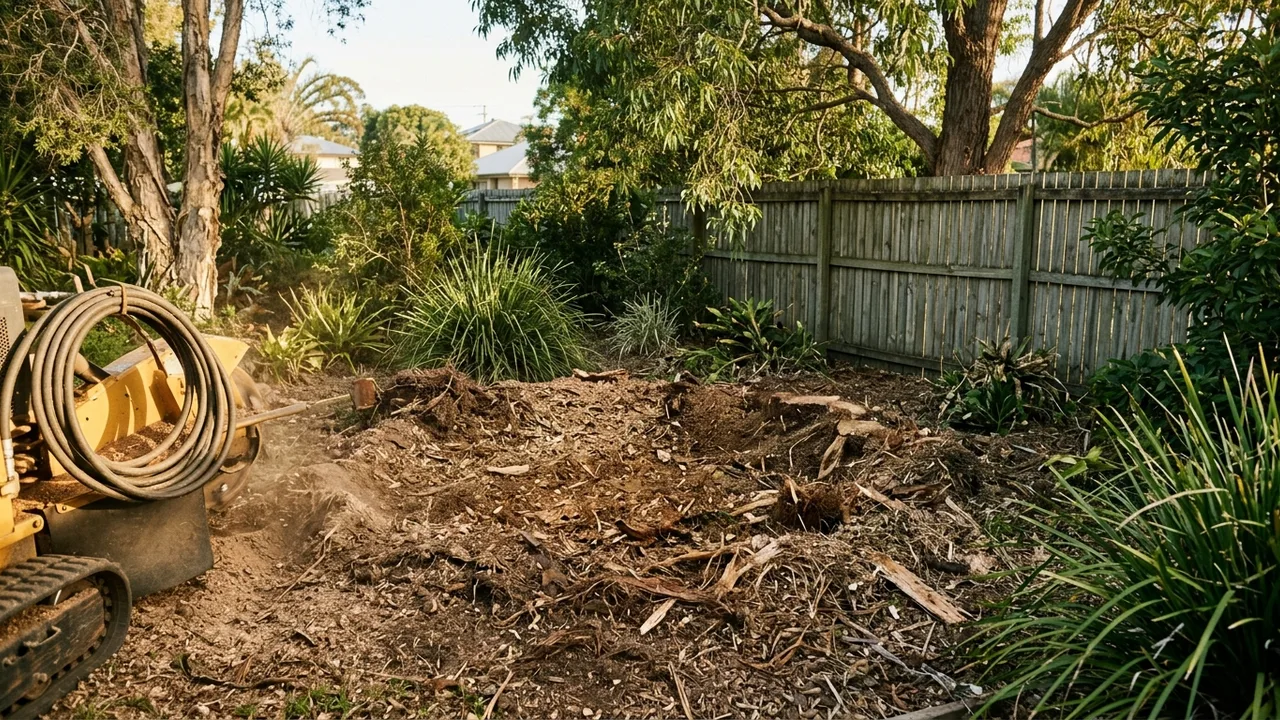
Stump grinding removes the stump and a significant portion of the root ball to below ground level, eliminating the primary food source. We grind stumps to 200 to 300 millimetres below the surface as standard, which removes the majority of the usable wood mass. The remaining roots in the soil will dry out and decay more quickly once separated from the stump, and they offer far less hospitable habitat than the intact stump did. If there's an active colony present, grinding disrupts the nest but does not eliminate the colony. You may still want a pest inspection after grinding if you've seen signs of activity.
The honest comparison: grinding solves the stump problem permanently and removes the habitat. Chemical treatment manages the symptom without removing the cause. For most Brisbane homeowners concerned about termites, grinding is the more complete solution.
Brisbane-Specific Factors Worth Knowing
A few things make this issue more pressing here than in cooler or drier parts of Australia.
Soil type and moisture retention. Much of the Inner West sits on clay-heavy soil that retains moisture well. That benefits gardens but also keeps stumps damp and speeds up the decay that termites rely on. Properties near Oxley Creek in Corinda and Sherwood, or close to the Brisbane River flood corridor, tend to have persistently moist subsoil even in dry months.
Tree species legacy. Older streets in Chelmer, Indooroopilly, and St Lucia were planted with substantial shade trees decades ago. Many of those trees are now at end of life or have been removed after storm damage. Jacaranda, Camphor Laurel, Poinciana, and large Figs leave stumps of significant diameter — sometimes 600 to 900 millimetres across — which take proportionally longer to decay and provide more material for termites to work through.
Storm events. Brisbane's storm season between November and March regularly brings trees down across these suburbs. A storm-felled tree creates an immediate stump, and the disturbed root system often provides instant access to moist interior wood. Emergency stump clearance after a storm event reduces this risk quickly.
Proximity to bushland. Suburbs on the escarpment edge like parts of Taringa and Indooroopilly border bushland reserves where termite colonies are well established. Properties near these areas face higher baseline termite pressure regardless of stumps.
What We'd Recommend
If you have a stump on your property and you're in Brisbane's Inner West, get it ground out sooner rather than later. The cost of stump grinding, typically $200 to $600 for a single residential stump depending on diameter and access, is modest compared to the cost of termite remediation and structural repair if a colony establishes a pathway to your home.
If you've seen signs of active termite activity at or near the stump, talk to a licensed pest controller before grinding. They can assess the colony, recommend treatment, and confirm whether the stump can be safely removed or needs a treatment-first approach. That sequencing matters.
If you have multiple stumps, grinding them in a single visit is more cost-effective. We offer multi-stump pricing for same-day work across the property, which brings the per-stump cost down meaningfully.
And if you're genuinely unsure whether that old stump in the corner of your yard is something to worry about, a quick look by someone who knows what to look for costs nothing. Give us a call and describe what you've got. We cover Chelmer, Sherwood, Graceville, Indooroopilly, Taringa, St Lucia, Corinda, Yeronga, Fairfield, and Moorooka, and we're usually able to get eyes on a job within a few days.
Quick answers