Stump Grinding guide
Do Old Tree Stumps Actually Attract Termites in Brisbane?
Do Old Tree Stumps Actually Attract Termites in Brisbane?
Yes, old tree stumps do attract termites, and in Brisbane's subtropical climate the risk is real enough to take seriously. A rotting stump in your backyard is not a guaranteed termite magnet on day one, but given enough time and moisture it becomes exactly the kind of habitat that subterranean termite colonies actively seek out.
That said, the relationship between stumps and termites is a little more nuanced than "stump equals infestation". Understanding what actually happens, and when it becomes a problem for your home, will help you make a smarter decision about what to do.
Why Stumps Become Attractive to Termites
Termites eat cellulose. Softening, decaying timber is far easier for them to process than hard, dry wood, so a stump that has been sitting in the ground for a year or two is essentially a pre-softened food source at ground level.
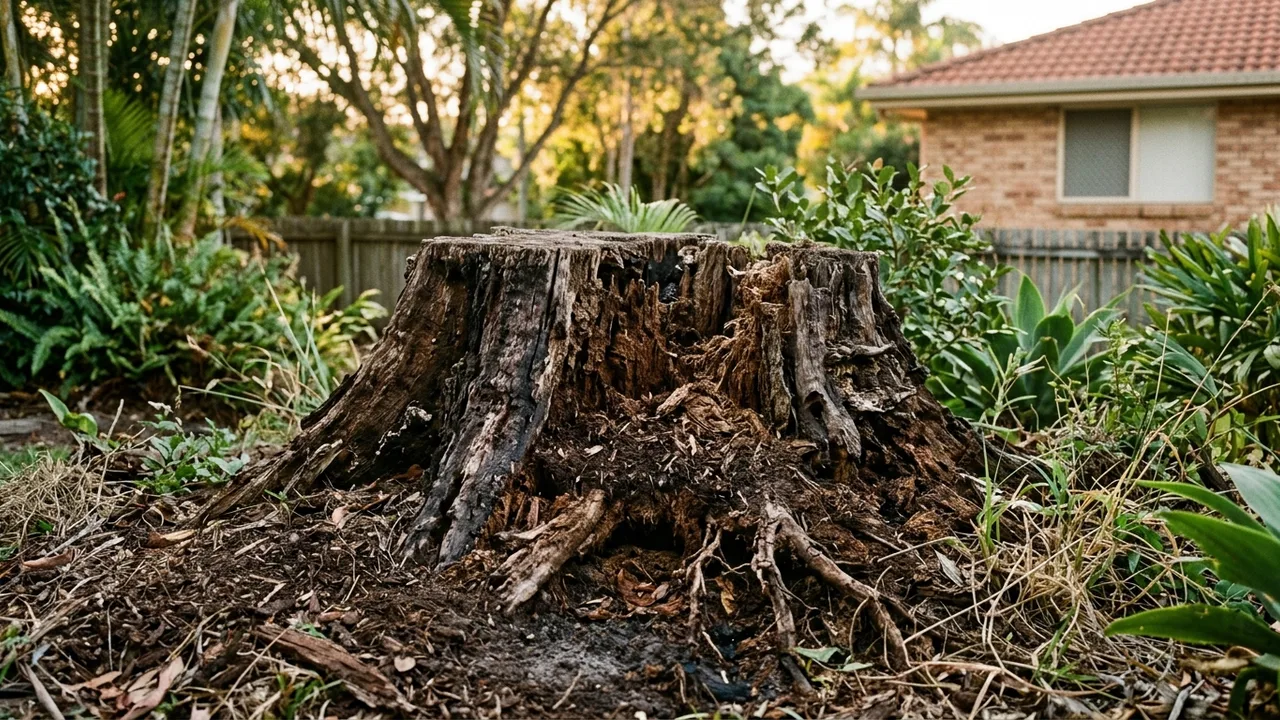
The key factors that turn a stump from a garden eyesore into a genuine risk:
- Moisture retention. A stump in contact with Brisbane's warm, humid soil holds moisture well. The inner heartwood breaks down slowly, creating conditions that subterranean species, particularly Coptotermes acinaciformis (one of Queensland's most destructive termite species), actively seek.
- Root network. The lateral roots spreading out from a stump do not die immediately. They decay over months or years, creating a web of soft timber pathways through the soil, sometimes running toward a fence, a garden bed retaining wall, or the subfloor of a Queenslander.
- Ground contact. Unlike timber in your wall framing, a stump sits directly in the soil. Termites rarely need to construct mud tubes to reach it. They can travel from their colony through the soil and into the stump without ever breaking the surface.
None of this means a freshly cut stump will be colonised within weeks. Typically, the risk escalates once decay has softened the wood and the stump has been in the ground for 12 to 24 months or more.
The Brisbane and Inner West Context
Brisbane's climate accelerates the decay process compared to cooler parts of Australia. The combination of warm winters, high summer humidity, and subtropical rainfall means that what might take three to four years to become a genuine problem in Melbourne can happen in half that time here.
In suburbs like Chelmer, Graceville, Sherwood, and Corinda, Queenslander homes are common. These homes are elevated on timber stumps (a completely different kind of stump, though the naming confusion is real), and the subfloor timber is already a known termite risk. A rotting tree stump in the same yard as a Queenslander subfloor is not a situation you want to leave unmonitored.
St Lucia, Taringa, and Indooroopilly also have significant tree canopy, meaning more large-diameter stumps from council-approved removals and storm damage. Some of these stumps are substantial, with root systems that spread under driveways and garden paths. In our experience grinding stumps across these suburbs, it is not unusual to find evidence of termite activity in stumps that homeowners assumed were harmless.
Yeronga, Fairfield, and Moorooka tend to have older housing stock on relatively tight blocks. Here, a stump near the fence line can sit close to a neighbouring property's structure, so what starts as your garden's problem can extend further.
How Close Is "Too Close to the House"?
There is no single safe distance. Pest inspectors often flag any stump within five to ten metres of a structure as worth monitoring, though Coptotermes acinaciformis colonies have been recorded foraging up to 50 metres from their central nest.
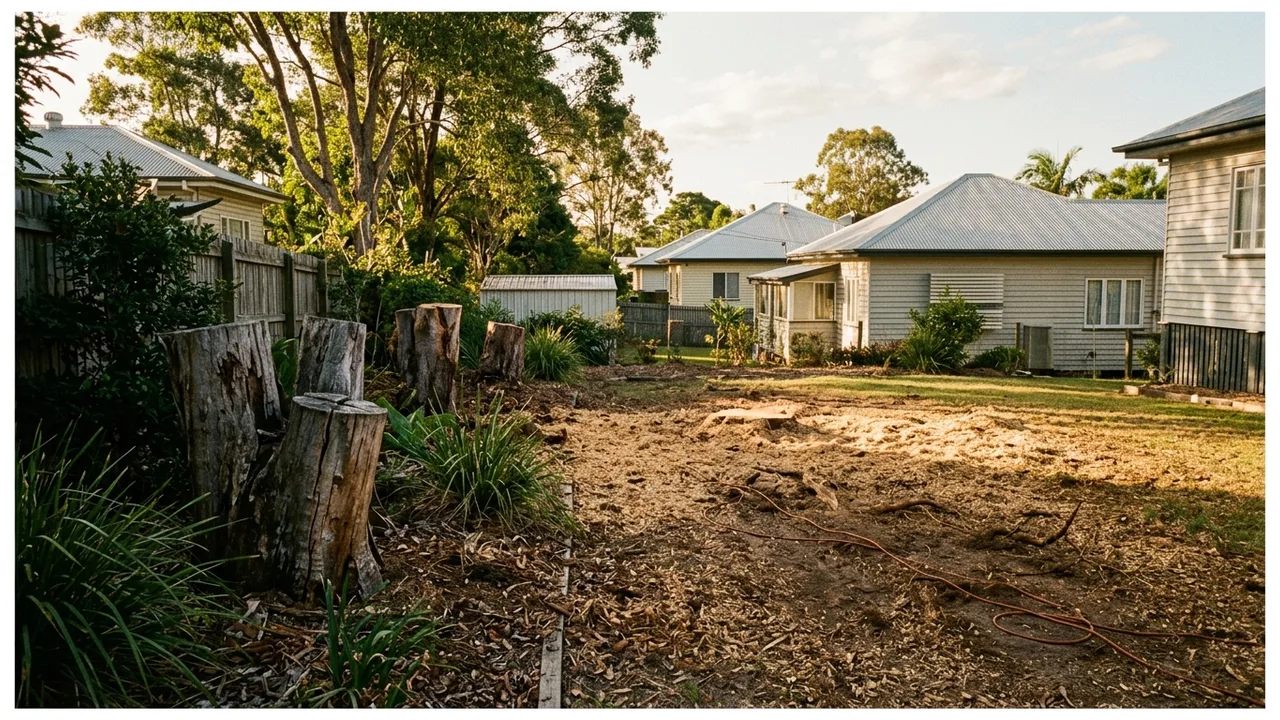
As a rule of thumb, the closer the stump to your home, the less margin you have. A stump at the back corner of a large block in Chelmer presents a different risk profile to one sitting two metres from the piers of a timber-framed Sherwood Queenslander.
The other factor worth considering is what else is nearby. Stumps adjacent to:
- Subfloor access points or timber piers
- Timber retaining walls
- Garden sleepers or raised beds made from organic materials
- Wooden fencing that contacts the ground
...carry a higher practical risk than an isolated stump in the middle of an open lawn.
Grinding vs Leaving It: An Honest Trade-off
Plenty of stumps sit in Brisbane backyards for years without causing a termite problem. So is it always worth grinding them out?
Here is an honest breakdown:
Arguments for leaving the stump
- If the stump is very small, very far from any structure, and decay is slow, the risk may remain low for a long time.
- Cost. Depending on diameter and access, stump grinding typically runs $200 to $400 for a single stump of average size, more for large hardwood stumps or difficult access. That is money spent on a risk rather than a confirmed problem.
- Some stumps are used as garden features or bench seats, and if they are treated and monitored, that is a valid choice.
Arguments for grinding it out
- Once termites establish in a stump, the colony can grow significantly before you see any visible sign. By the time you notice activity, it may already be larger than you assumed.
- Grinding eliminates the food source entirely rather than just treating it. Termite baits and treatments work, but they address the colony, not the stump that keeps attracting attention.
- Grinding also removes the root system (or at least significantly disrupts it), which reduces the pathways through the soil toward other timber.
- In Brisbane, a pest inspection costs $300 to $500 typically. If a termite inspector finds activity in a stump and then in your subfloor, the remediation costs dwarf the price of having the stump ground out earlier.
The practical position most building and pest inspectors take is straightforward: if a stump is within a reasonable distance of your home, grinding it is a more cost-effective prevention strategy than leaving it and monitoring.
What Grinding Actually Does (and Does Not Do)
Stump grinding removes the above-ground portion and grinds the stump to below-ground level, typically 150 to 300 millimetres below the surface. This removes the bulk of the food source and disrupts the surface structure that termites were colonising.
It does not remove every last root. Lateral roots spread wide, and while deep root grinding (which we can carry out as part of a root system removal service) targets the major lateral roots, some fine root material remains. This is normal, and the fine roots decay quickly without the stump to sustain them.
If there is already active termite activity in the stump at the time of grinding, grinding alone does not eliminate the colony. The colony lives underground, often some distance from the stump. Grinding removes the food source and disrupts the surface access point, but you would still want a licensed pest controller to assess whether baiting or treatment is needed for the colony itself.
This is an important point: stump grinding and termite treatment are complementary, not interchangeable.
What to Do If You Have an Old Stump in Your Yard
If the stump has been in the ground less than 12 months and shows no visible softening or insect activity, you have time to assess. Keep an eye on it, particularly after wet weather, and look for mud shelter tubes, soft crumbling wood, or unusual insect activity at ground level.
If the stump is older, visibly decaying, or within five to ten metres of any timber structure, the sensible move is to have it ground out sooner rather than later. If you already suspect termite activity, get a pest inspection first so you know what you are dealing with before the grinding disturbs anything.
For properties in Chelmer, Graceville, Sherwood, Corinda, Yeronga, Fairfield, and the surrounding Inner West suburbs, we offer single stump grinding and multi-stump packages across the same visit if you have more than one to deal with. We can also handle the mulch clean and haul if you want the site left tidy.
If you want to talk through your specific stump situation before booking, we are happy to give you a straight answer about whether it looks like a genuine concern. No obligation, just a practical conversation.
Quick answers