Stump Grinding guide
When Should You Grind a Stump After a Tree Comes Down?
The Short Answer
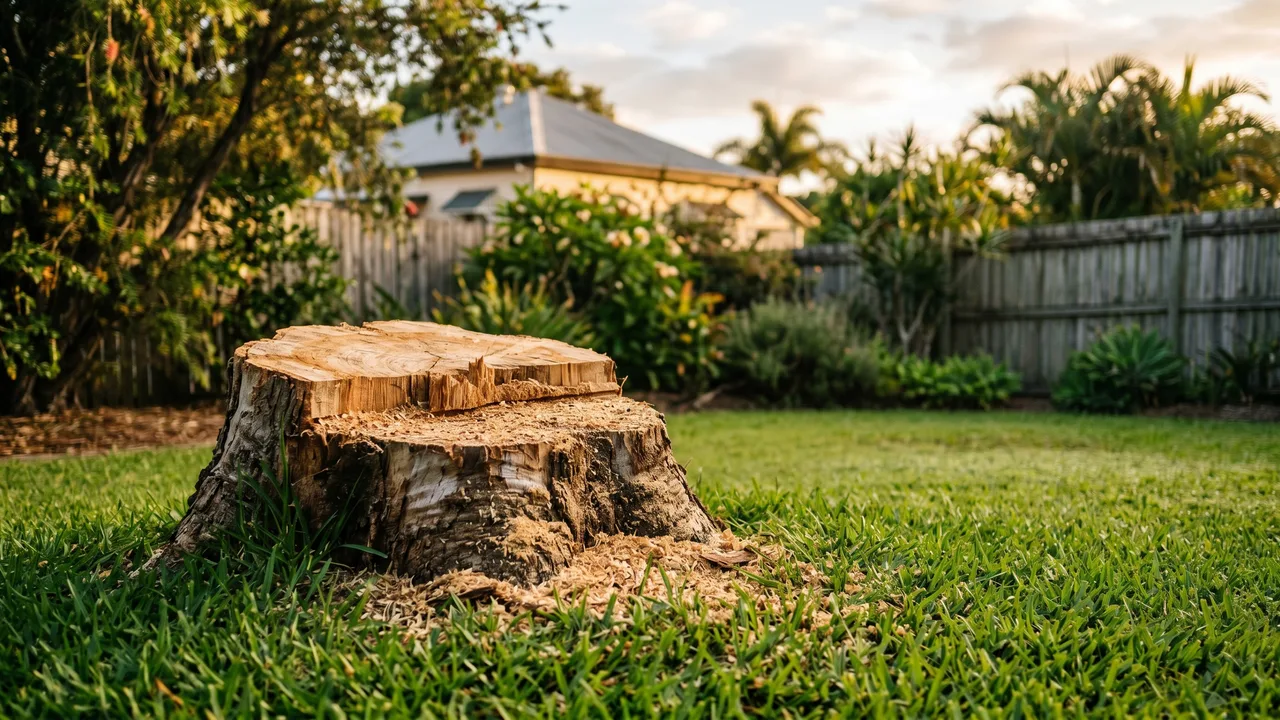
Grind the stump as soon as the tree is removed, if you can. That is almost always the right call. Leaving a fresh stump in the ground invites problems that compound over time, and in Brisbane's subtropical climate, those problems arrive faster than most people expect.
That said, timing does depend on a few real factors: what you plan to do with the space, the species of tree, your budget, and what is beneath the ground. Here is how to think it through properly.
Why Timing Matters More in Brisbane Than Elsewhere
Brisbane's climate accelerates everything. Warm temperatures and reliable humidity mean a freshly cut stump can start harbouring termites within a few months. This is not a scare tactic. Subterranean termites are common throughout the Inner West, from Chelmer and Graceville through to Fairfield and Moorooka. A dead stump is exactly the kind of damp, cellulose-rich material they seek out.
Fungal growth follows a similar pattern. White rot and bracket fungi establish themselves quickly on decaying timber in this climate, especially during and after our wet season. Once a stump is colonised, the fungal network can spread into adjacent soil and, in some cases, affect nearby healthy trees or garden plants.
There is also the regrowth issue. Many native and common suburban species in this part of Brisbane will shoot from a cut stump with remarkable determination. Camphor laurel, privet, and some fig varieties will send up new growth within weeks. Grinding sooner eliminates that regrowth problem before it starts.
Reasons You Might Wait (and Whether They Hold Up)
It is fair to ask whether waiting ever makes sense. Sometimes it does.
Cost timing. If the tree was removed after an unexpected expense (a council-required removal, say, or storm damage), you might want a few weeks before spending more. That is a perfectly reasonable position. A stump is not going to create an emergency in three or four weeks. Give yourself breathing room if you need it, but try not to let months slide into a year.
Multiple stumps. If you have more than one stump across the property but cannot address all of them at once, it can be worth waiting until you can book a single visit. We offer multi-stump packages precisely because combining jobs in one visit saves you money compared to booking separate jobs on separate days. If you have a second tree coming down in a month, it can make sense to hold off and do both together.
Landscaping plans are unclear. If you are not sure yet whether the space will become a garden bed, lawn, driveway extension, or deck footings, the grind depth and approach will differ. A Garden Bed Prep Grind is calibrated differently to a full below-ground grind for turf or concrete. Knowing your plan before the job means better results and no do-overs. Taking two to three weeks to decide is sensible. Taking two years is not.
Waiting periods that do not hold up. Some people believe you should wait for the stump to dry out or die back before grinding. In practice, this does not make the job meaningfully easier, and it adds all the risks mentioned above. Stump grinders work on fresh and aged stumps alike.
Species Makes a Difference in the Inner West
The tree species matters more than most people realise. In the suburbs we cover, including Indooroopilly, Taringa, St Lucia, and Sherwood, a handful of species come up again and again, and each has its own behaviour.
- Camphor laurel is everywhere in this part of Brisbane. It is a prolific resprouter. Grind promptly, and consider a root system removal if the lateral roots are extensive, since camphor roots can heave paths and driveways.
- Jacaranda is beloved but has a broad, shallow root system. The grinding itself is typically straightforward. The lateral roots can extend well beyond the canopy edge, which matters if you are near a driveway or footpath kerb.
- Poinciana has dense, hard timber and a root system that can be genuinely aggressive toward underground services. Worth having the grinding contractor aware of any irrigation lines or drainage before they start.
- Brush box and eucalypts tend to have deep tap roots. They are less likely to cause surface path damage but can be more demanding to grind fully.
- Figs of various kinds (Port Jackson, Moreton Bay) are notorious for lateral roots. On properties in Yeronga, Fairfield, and Chelmer near older housing, these trees have sometimes been growing for forty or fifty years. The root system can be extensive, and full root removal rather than a surface grind is often the right choice if the roots are near footings or drainage.
What Happens If You Leave It Too Long
Here is what typically plays out over an eighteen-month-to-two-year period with an untreated stump in the Inner West.
The stump begins to decay, which is actually harder to grind in some ways because the timber structure collapses unpredictably. Termite activity increases the risk of colony establishment near the house. Fungal growth can affect soil pH around the stump, which matters if you want to plant in that area later. The root system continues to decompose and can leave voids in the soil, which occasionally cause subsidence in paths or garden edges over time.
Aesthetically, an old stump becomes a hazard for anyone walking across the lawn and a mowing obstacle that damages equipment. None of these things are catastrophic on their own. Combined, they justify the $200 to $700 a typical single residential stump costs to grind.
What to Expect From the Job Itself
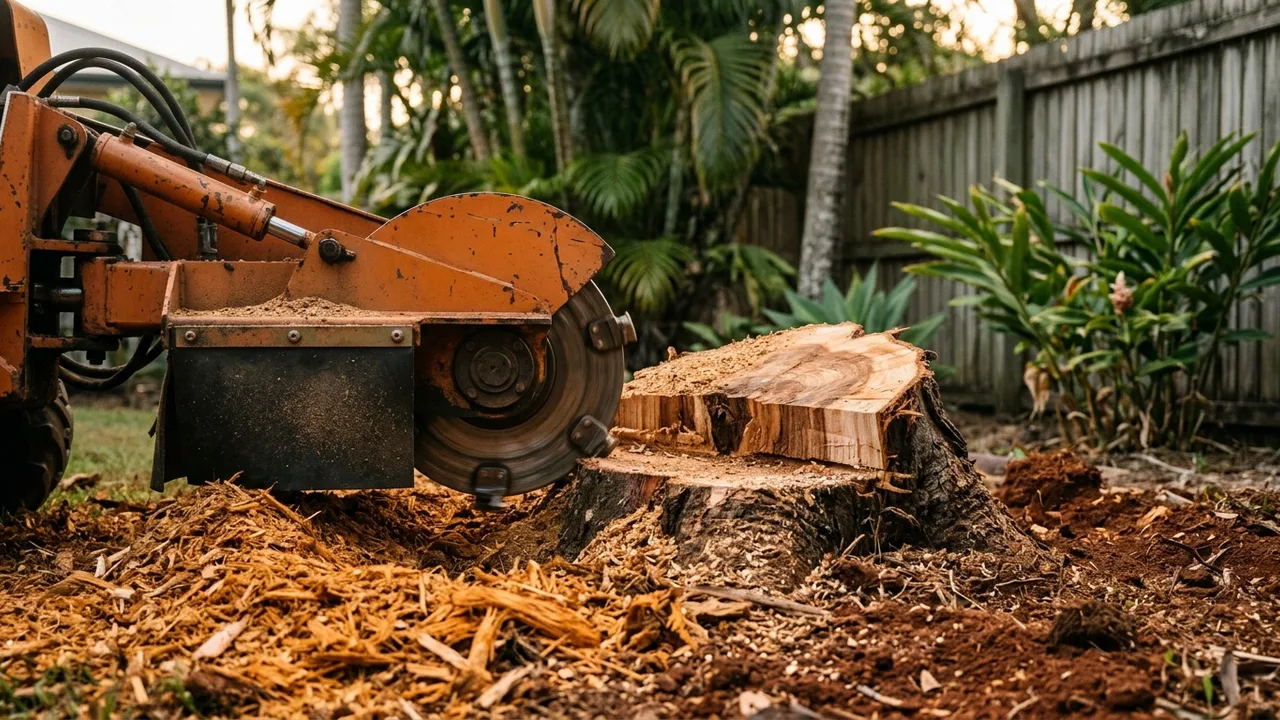
Stump grinding is mechanical work. A grinder with a rotating cutting wheel works across the stump in passes, reducing timber to chips and sawdust. For a standard residential stump we typically grind to 150-300 mm below the surface, which is deep enough for turf to establish. For a garden bed with planting, the target depth is calibrated to avoid disturbing existing root systems and soil layers unnecessarily.
The grindings (the mulch-like material left behind) can be left in the hole as a filler that will settle over time, or removed entirely via a Mulch Clean and Haul. If you are laying turf or pouring concrete, removal is the better option. If you are mulching a garden bed, leaving the grindings in place is often fine, though fresh grindings can temporarily tie up nitrogen in the soil as they decompose, so hold off on planting for a month or two if you can.
For root system work near paths, driveways, or underground services (stormwater, irrigation, NBN conduit), the job becomes more detailed and takes longer. Let the operator know in advance so they can quote accurately and bring the right equipment.
A Practical Recommendation
If the tree is already down, do not wait for a special reason. Book the grind within a few weeks, especially if you are anywhere in Brisbane's Inner West where the climate speeds up decay and pest activity.
If you have two or more stumps on the property, or another tree coming down soon, coordinate the timing so they can be handled in one visit.
If you are unsure what you want to do with the space, take a week or two to decide. It is worth knowing before the crew arrives, because the right grind depth depends on what comes next.
We cover Chelmer, Graceville, Sherwood, Corinda, Indooroopilly, Taringa, St Lucia, Yeronga, Fairfield, and Moorooka. If you want a straightforward quote with no obligation, get in touch and describe the stump (species if you know it, approximate diameter, and what is nearby). That is enough to give you a realistic number.
Quick answers